
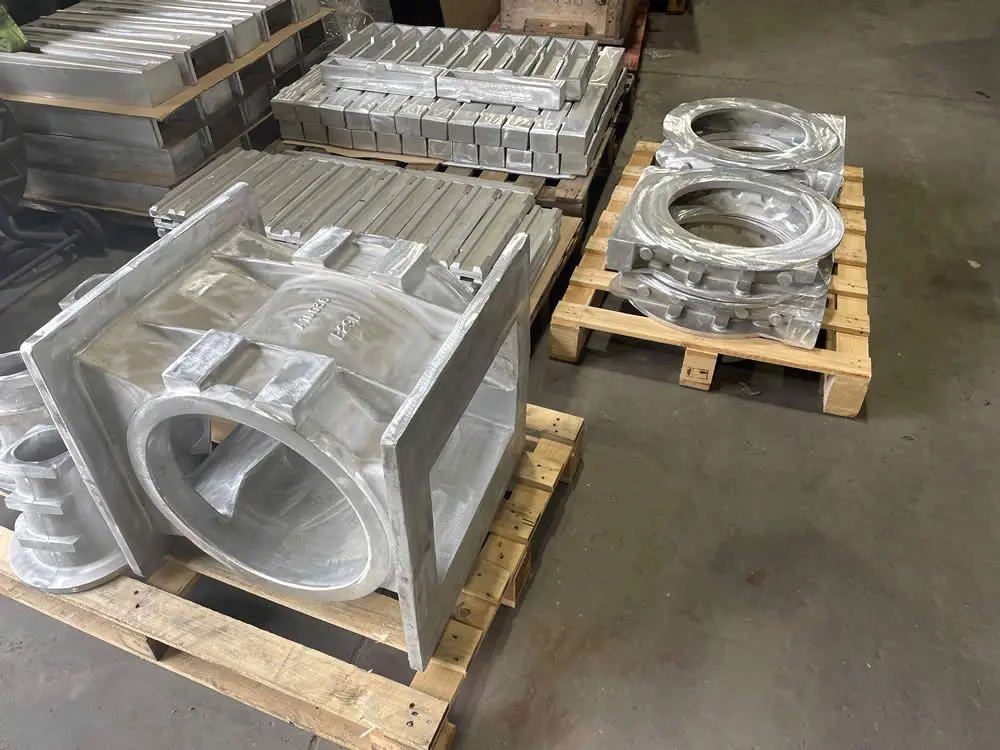
If your components require precision, aluminium casting tolerances become one of the most critical aspects of your part specification. At Arrow Butler Castings, we work closely with design engineers and procurement leads to achieve the best balance between tolerance control, mechanical integrity, and cost-effectiveness.
This article explains how aluminium casting tolerances are defined, what impacts them, and how to maintain strength while meeting tight dimensional requirements.
What Are Aluminium Casting Tolerances?
Casting tolerances define the allowable dimensional variation on a cast component. These can range from ±0.25 mm to ±1.5 mm depending on:
- Casting method (sand vs gravity die casting).
- Part geometry.
- Wall thickness.
- Material shrinkage characteristics.
- Tooling accuracy and wear over time.
Tighter tolerances reduce variation – but they also increase tooling complexity, post-processing time, and cost.
Balancing Tight Tolerances and Structural Strength
Tight tolerances can’t come at the expense of part performance. To maintain integrity:
- Avoid sharp internal corners which concentrate stress.
- Maintain minimum wall thicknesses suitable for the alloy and method.
- Use proper draft angles to ensure full fill and easy release.
- Avoid unnecessary post-machining unless critical.
At Arrow Butler, we help you design for casting success – not just machining precision.
Casting Tolerances vs. Machined Tolerances
| Characteristic | Casting Tolerance | Machined Tolerance |
|---|---|---|
| Typical range | ±0.5-1.5 mm | ±0.01-0.1 mm |
| Cost | Lower upfront | Higher (secondary ops) |
| Speed | Faster production | Slower cycle |
| Surface finish | As-cast or improved | Consistent |
Use casting tolerances for non-critical areas and machine only where essential – a hybrid approach that improves cost and lead time.
The Role of Draft Angles in Tolerance and Release
Draft angles are taper allowances (typically 1°-3°) built into vertical faces of castings to:
- Ensure smooth release from the mould.
- Prevent drag and deformation.
- Reduce dimensional defects.
The tighter the tolerance, the more precise the draft angle design must be. We provide DFM (Design for Manufacture) feedback to ensure your drawings are tooling-ready.
Linear vs Geometric Tolerances
Both are used in aluminium casting, but they control different outcomes:
- Linear Tolerance: Direct control of dimensions (e.g., ±0.5 mm on length or diameter).
- Geometric Tolerance: Controls shape and location (e.g., flatness, circularity, concentricity).
Geometric tolerances often require CMM inspection and higher-precision tooling. We advise on which tolerance type suits your performance spec.
Optimising Tolerances with Cost in Mind
Designers sometimes default to ultra-tight tolerances across the board, which can:
- Overcomplicate tooling.
- Increase scrap rates.
- Raise machining costs.
Instead, define critical-to-function dimensions, and let non-critical surfaces remain within general casting tolerance ranges. We’ll help you prioritise what matters most.
Arrow Butler’s Tolerance Capability
- Gravity Die Casting: ±0.25 to ±0.75 mm (machined: ±0.05 mm).
- Air Set Sand Casting: ±0.75 to ±1.5 mm (machined: ±0.1 mm).
- Wall Thickness Min: 3.5 mm (gravity) / 6 mm (sand).
- Machining: CNC, CMM inspection, jigged setup.
- Alloys Supported: LM25, LM6, LM27.
FAQs
1. How tight can aluminium casting tolerances be?
Gravity die casting can achieve ±0.25 mm. For tighter specs, we recommend machining post-cast features.
2. What affects tolerance in casting vs machining?
Casting tolerances are influenced by shrinkage, mould design, and part geometry. Machining offers tighter control but adds time and cost.
3. Can tight tolerances be achieved without post-processing?
Yes, on some features. But critical dimensions usually require machining, especially for fitment or sealing zones.
4. What’s the role of draft angles in tolerance control?
Draft angles allow the moulded part to release cleanly. Without correct draft, dimensions can warp or vary, especially on vertical walls.
5. What’s the difference between linear and geometric tolerance?
Linear tolerances control size; geometric tolerances control shape and location. We help you apply the right method for your function-critical specs.
Send Your Spec for Tolerance Analysis
Want to confirm if your part can be cast within your spec?
We offer free tolerance reviews and DFM feedback before tooling begins.
Contact Arrow Butler Castings Ltd
Wittington Way, Chesterfield, Derbyshire S41 9ES
Call: +44 (0)1246 450027 | Email: [email protected]